By Will Reaume

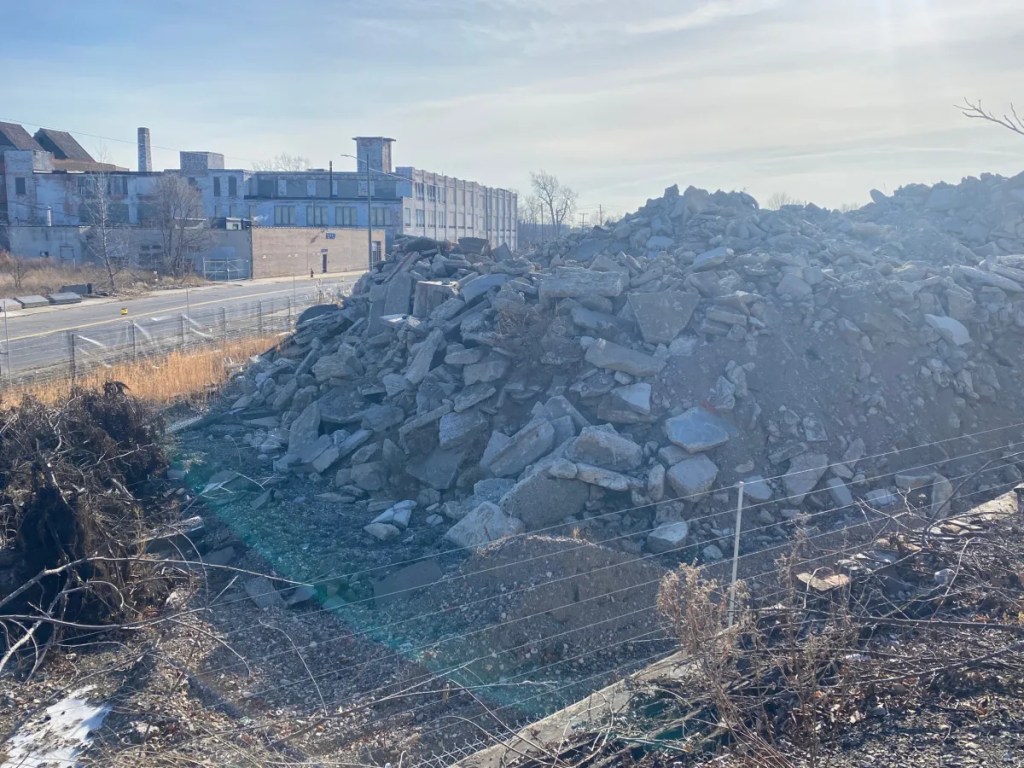
Amidst a backdrop of homes and urban gardens in Core City, sits a toppling mound of crushed concrete and a whirling cloud of dust above it. The industrial site is the home of a proposed concrete crushing facility, owned by Murray Wikol and his Troy-based development firm, ProVision. Residents and local environmental activists point to more than just the ugly exterior as cause for alarm.
Activist groups, like Core City Strong, are pushing back against Wikol and his development plans for the land. So far they have been successful at rallying community support against the “Core City Concrete Crusher”, and have been able to stop the site from operating as intended.
Vanessa Butterworth-Serna, co-founder of Core City Strong, is the newest activist in the neighborhood’s long history of social justice. After the organization’s founding, she recalls hearing about a group of Core City nuns in the 60s that brought goats to Detroit City Hall to protest the city’s neglect of their neighborhood.
Butteworth-Serna believes Wikol needs to be held accountable. Despite recent court rulings barring him from operating a concrete crushing facility at the site, she says work is still going on at the property and that Wikol is not taking the proper precautions for controlling the spread of dust.
“During the April 4th city planning commission hearing, Wikol kept saying that we’re moving things around and we’re using all the fugitive dust practices to keep it down, but I watch them every day and there’s no water truck and there’s no rack-out controls. He’s just lying,” Butterworth-Serna says.
Made up of mineral micro-particles, “fugitive dust”, is a pervasive and harmful phenomena that occurs as the result of dry conditions and improper disposal methods. The dust is composed primarily of silica, a component in concrete, and exposure to this noxious powder can result in asthma and other forms of poor lung functions. Butterworth-Serna talks more in-depth about its effects in an interview.
Detroit’s Buildings, Safety Engineering, and Environmental Department has issued over 62 blight tickets against Wikol and for failure to clean up the lot. Wikol currently owes the city of Detroit almost $140 thousand in tickets and fines related to his ownership of the property. The city also issued a public nuisance lawsuit against Wikol for the debris and improper storage of solid waste. This timeline outlines the major dates surrounding the site.
Jimmy Counts, a nearby Woodbridge resident, drives through Core City everyday on his way to work. He says during his short ride in the four-square mile neighborhood, his car often gets covered with dust.
“It’s definitely annoying. I’m in Core City for maybe two or three minutes, and depending on the weather that day, there might be a dust fkying everywhere. I can’t imagine what it’s like for people that live right next to these kinds of industrial sites,” Counts says.
In a conversation between Butterworth-Serna and Wikol, he asked Core City Strong to help convince the city of Detroit to drop their suit against him. Butterworth-Serna said this was something they vehemently opposed.
“In the call he said, I’m a religious man and I realized that having a concrete crusher inside the community isn’t the best thing, and I don’t have to use the property for that. I’m willing to work with you, but can you tell the city of Detroit to drop the lawsuit. Right then and there we said we don’t want anything to do with you,” Butterworth-Serna says.
She says that his comments over the phone conflicted with the loud and incoherent rant he went on at the April 4 hearing. In the call, he told Butterworth-Serna that he was not at all opposed to downzoning the lot, nor was he against moving out of the area completely.
“During the first hearing with the city planning commission, Wikol showed up and railed against the proposal to downzone and started inarticulately yelling into the microphone,” Butterworth-Serna says.
Butterworth-Serna believes Wikol’s actions constitute environmental racism, as Core City is a predominantly Black neighborhood. She also doesn’t think he expected to receive so much pushback, which is partly why he bought the property for $1,300 in 2013 from Wayne County.
“I truly believe that he thought that since it’s a lower income black neighborhood nobody would care and he can do whatever he wants there. But that’s not the case,” Butterworth-Serna says.

She also believes that Wikol, who is the grandson of former Michigan Gov. Murray Van Wagoner, has tried to use his influence and privilege to have this issue squashed. But she and other Core City residents aren’t letting that happen.
This is not an isolated issue. Core City is currently zoned industrial, which means that others like Wikol could operate similar businesses within the neighborhood. Core City Strong is spearheading efforts to “downzone”, which would ban sites like Wikol’s and transition to more residential friendly zoning.
The rezoning proposal would change the area from an M4 intensive industrial zone to a SD2 Special Development District, Mixed-Use zone. SD2 zones are “designed to encourage a complementary mixture of more intensive pedestrian and transit-oriented uses that may be compatible with a neighborhood center or with a location along major or secondary thoroughfares.” Butterworth-Serna hopes that with SD2 zoning in place, affordable housing and less environmentally impactful businesses could take the place of the heavy industrial sites.

Currently, Core City Strong’s rezoning proposal has been approved through a unanimous vote by the Detroit City Planning Commission on April 4. Butterworth-Serna hopes that the proposal, which Mayor Duggan has spoken in support of, will be in front of Detroit City Council within the next month.
 Reaume Writes
Leave a comment